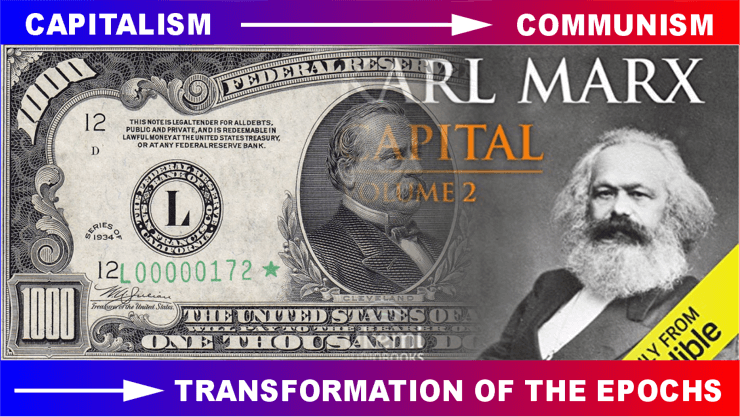
HERE YOU CAN STUDY MARX & ENGELS' “CAPITAL”,
but there is also a lot of ready-made information here, such as video lectures,
which you can use for a long time while we prepare everything else. GOOD LUCK!
The Law of Functioning of Modern Society (then – the Capitalism)
A Critique of Political Economy
(of Science & Practice)
Electronic and Online Versions of
„CAPITAL“
You must start from the beginning and not skip a single word, because this is science, not an entertaining novel. The conceptual apparatus, and specifically that of microeconomics (production, value, distribution—i.e., Marxism), is no longer officially studied anywhere in the formerly falsely named “Socialist Countries” (they should normally be called “Countries of the State Capitalism”). The elimination of microeconomics began as early as the start of the 1970s and concluded in the early 1980s, so that the newly hatched party capitalists (oligarch-mafiosi) could effortlessly and with impunity steal not only the so-called “unpaid labor” of the worker directly from production, but also directly from the state budget. Until 10 years ago, “Capital” was still studied in many higher education institutions in the USA, including the doctrine of classes and class struggle, while in the former countries of Party Capitalism (the Socialist Bloc), microeconomics personnel were repressed and dismissed from their jobs, and the theory completely disappeared as an academic discipline. Thus, slowly over 10 years, from the 1980s to the 1990s, the coups d'état in these countries were prepared, led by the greatest traitor in all of history—Mikhail Sergeevich Gorbachev in the USSR.
cc0
VOLUMES
ONE, TWO, THREE, FOUR
We still do not have the capacity to publish the luxury and online versions of “Capital” (Das Kapital)—all our efforts are concentrated on translating and publishing our own discoveries here, which you cannot find anywhere else. Therefore, we will only limit ourselves to some video lectures on “Capital” by American professors.
99.99% of people know nothing about Marx and Engels's “CAPITAL”. Most hate it simply because their brains are easily “brainwashed” by the colossal quantity of lies circulated by the currently ruling politicians, by academic-bureaucrats on the payroll of the ruling class, by bribed media, and so forth. Let the curious here at least know the headings from the different sections of the table of contents of “CAPITAL”.
At least see with your own eyes the colossal effort Marx and Engels put into writing and publishing it. See with your own eyes the topics that are analyzed and mathematically proven in this epochal scientific work. Because 99% of people imagine that this is some sort of politically-motivated “lure” for gaining electorates, detached from reality. Here you will see if that is the case!
TABLE OF CONTENTS
Volume I.
– Forewords and Afterwords
The Process of Production of Capital
– Part 1: Commodities and Money
– Part 2: Transformation of Money into Capital
– Part 3: The Production of Absolute Surplus-Value
– Part 4: Production of Relative Surplus-Value
– Part 5: Production of Absolute and Relative Surplus-Value
– Part 6: Wages
– Part 7: The Accumulation of Capital
– Part 8: Primitive Accumulation
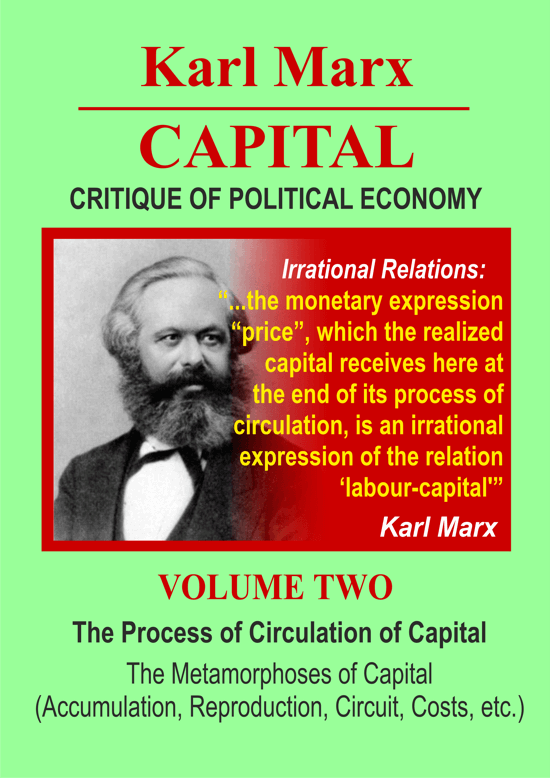
Volume II.
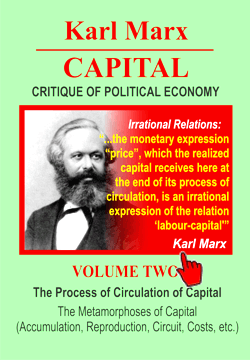
The Process of Circulation of Capital
– Part 1: The Metamorphoses of Capital and their Circuits
– Part 2: The Turnover of Capital
– Part 3: The Reproduction and Circulation of the Aggregate Social Capital
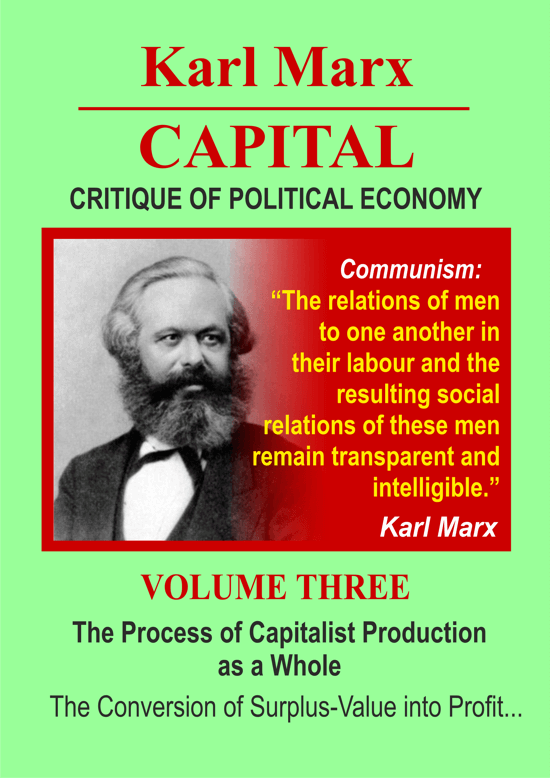
Volume III.
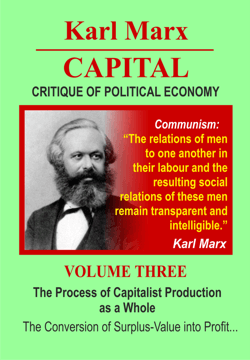
The Process of Capitalist Production as a Whole
– Part 1: The Conversion of Surplus-Value into Profit and of the Rate of Surplus-Value into the Rate of Profit
– Part 2: Conversion of Profit into Average Profit
– Part 3: The Law of the Tendency of the Rate of Profit to Fall
– Part 4: Conversion of Commodity-Capital and Money-Capital into Commercial Capital and Money-Dealing Capital (Merchant's Capital)
– Part 5: Division of Profit into Interest and Profit of Enterprise. Interest-Bearing Capital
– Part 6: Transformation of Surplus-Profit into Ground-Rent
– Part 7: Revenues and their Sources
– Supplement by Frederick Engels
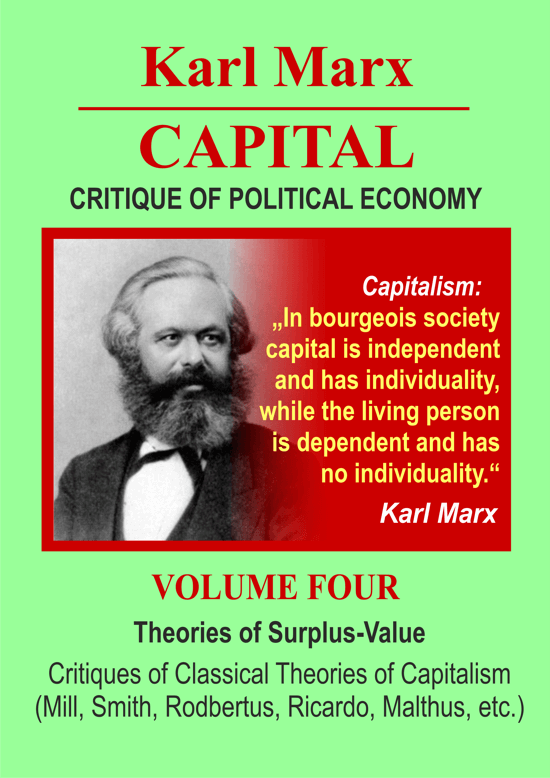
Volume IV.
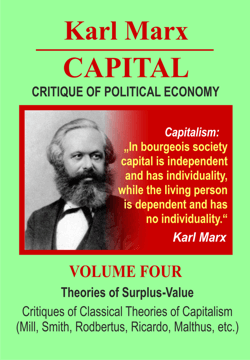
THEORIES OF SURPLUS-VALUE
– PART I
[Chapter I] Sir James Steuart
[Chapter II] The Physiocrats
[Chapter III] Adam Smith
[Chapter IV] Theories of Productive and Unproductive Labour
[Chapter V] Necker
[Chapter VI] Quesnay’s Tableau Économique
[Chapter VII] Linguet
Addenda to PART I
– PART II
[Chapter VIII] Herr Rodbertus. New Theory of Rent.
[Chapter IX] Notes on the History of the Discovery of the So-Called Ricardian
Law of Rent.
[Chapter X] Ricardo’s and Adam Smith’s Theory of Cost-price (Refutation)
[Chapter XI] Ricardo’s Theory of Rent.
[Chapter XII] Tables of Differential Rent and Comment
[Chapter XIII] Ricardo’s Theory of Rent (Conclusion)
[Chapter XIV] Adam Smith’s Theory of Rent
[Chapter XV] Ricardo’s Theory of Surplus-Value
[Chapter XVI] Ricardo’s Theory of Profit
[Chapter XVII] Ricardo’s Theory of Accumulation and a Critique of it. (The
Very Nature of Capital Leads to Crises)
[Chapter XVIII] Ricardo’s Miscellanea. John Barton
Addenda to PART II
– PART III
[Chapter XIX] Thomas Robert Malthus
[Chapter XX] Disintegration of the Ricardian School
[Chapter XXI] Opposition to the Economists (Based on the Ricardian Theory)
[Chapter XXII] Ramsay
[Chapter XXIII] Cherbuliez
[Chapter XXIV] Richard Jones
Addenda to PART III. Revenue and its Sources. Vulgar Political Economy
VIDEO COURSES FOR STUDYING
„CAPITAL“
by two sensational professors of economics in the USA:
Professor Richard Wolf, USA
Professor David Harvey, USA
Let it be clear from now on to anyone intending to read “Capital” (Das Kapital): This is a scholarly work intended for scientists who must have several sequentially connected goals:
1. To understand the mechanisms of societal movement, its drawbacks, and its advantages.
2. To strive to improve the advantages and eliminate the drawbacks.
3. To build a new society, preserving the advantages of the old and finding new principles for development.
That is, Marx’s goal in writing “Capital” was not to create a PARTY IDEOLOGY to divert the masses and lead them nowhere, but quite the opposite—to eliminate politics [politicians and the political party system that justifies the plunderer (capitalism)] from the economy and to provide a new science of society to those who possess the intellectual and physical strength to fight for change. This means that few are those who possess the strength and desire to develop in any science.
That is, if you hope to enrich yourselves here only ideologically—i.e., to “stuff yourselves” with scholarly phrases and quotes without wanting to apply what you have learned in practice, particularly in microeconomics (in the labor and management tasks of production)—then you will be deceiving yourselves. Because your goals and the goal of this work by Marx will be antagonistic, and this will generate a moral conflict between you and Marx's objective, and you will ultimately waste your time.
In other words, this page here is intended for people who want to DEDICATE themselves by VOCATION to the science of economics (not to politics) and who are willing and able to allocate effort and extended time for this (months, years, and even... an entire lifetime, as Marx himself did). VOCATION is a much higher intellectual level than Professionalism—the former is your Spiritual Path, while the latter is mere selfish profiteering.
Let me clarify that mastering and applying “Capital” (Das Kapital) in economic practice is a necessary, but insufficient, condition for building communism. You will understand why from our scientific works. If “Capital” were a sufficient condition, the falsely named “Socialist Bloc” (which was, in practice, State-Capitalist) would not have disintegrated and destroyed the countries within it.
.%*
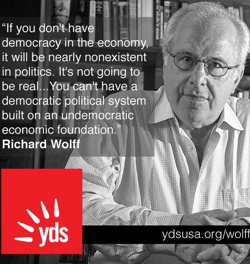
Let us start with the video lectures of economics professor Richard Wolff. To see what other PRACTICAL (non-political) activities he engages in, click the image:
Intensive Course for Beginners:
1
Introduction to Prof. Wolff’s Course on
the Practical Application of Marx’s “Capital”
2
Commodity and Money: The Historical Reasons
for their Emergence and Interdependence
3
Was There Socialism in the USSR and the Entire
“Socialist” Bloc, or is this the Deception of the Century?
4
The False Socialism in the Eastern Bloc and the
Future Revolution Towards True Socialism
Practical Course for Advanced Students:
1
Mechanisms for the Reproduction of the Robbery
Called “Surplus-Value”
2
Contradictions Between Financial and Production
Capital and their Mutual Transformation
3
The Antagonism Between Political and Production
Democracy: The Fraud Called “Democracy”
4
The State (Bureaucratic, Nomenklatura, Party...)
Capitalism in the Entire Socialist Bloc
 VIDEO LECTURES on “CAPITAL” (Das Kapital). Lecturer: DAVID HARVEY
Once again, a society with no party or political ambitions, dedicated to the enlightenment of the people—studying Marx's economic Theory of Value from his fundamental work with the goal of creating personnel for managing the future socialist economy of the United States—a completely pragmatic goal, unlike most seemingly "communist" party organizations around the world, which neglect the science of communism in favor of political appearances, completely doomed under the conditions of the oligarchic electoral and economic system.
The FIRST SERIES OF LECTURES covers Volume ONE, and the SECOND SERIES covers Volume TWO and in some lectures—partially, Volume THREE.
READING CAPITAL VOLUME ONE WITH DAVID HARVEY
1
Introduction to the Critique of Capitalism
2
Commodity and Money
3
Money or the Circulation of Commodities
4
The Transformation of Money into Capital
5
The Labour-Process & The Valorisation
6
The Struggle for the Normal Working Day
7
Relative Surplus-Value. Co-Operation
8
Machinery and Modern Industry (Part 1)
9
Machinery and Modern Industry (Part 2)
10
Surplus-Value Forms & their Transformation into Capital
11
The General Law of Capitalist Accumulation
12
The Primitive Accumulation of Capital & Colonization
13
Summary and Conclusion
READING “CAPITAL” VOLUME TWO WITH DAVID HARVEY
1
Introduction to Volume Two
by Prof. David Harvey
2
The Circulation of Money, Commodity & Productive
Capital
3
Time and Costs of Capital Circulation
in the Entire Societal Process
4
Fixed & Turnover Capital; Turnover Cycles;
Critique of Pre-Marxian Theories
5
Transformation of Capital; Turnover & Prices;
Merchant Capital History
6
Interest-bearing, Credit & Fictitious Capital;
Accumulation of Capital & Interest
7
Means of Capital Circulation;
Fictitious and Real Capital
8
The Time for Production and for Capital Circulation.
Production Period
9
Time and Magnitude of Turnover of Variable Capital;
Turnover of Surplus Value
10
Reproduction & Circulation of Entire Societal Capital;
Simple Reproduction
11
Reproduction, Circulation and Accumulation
of All Societal Capital
12
Preface & Summary of the Course of Entire
First & Second Volumes of “Capital”
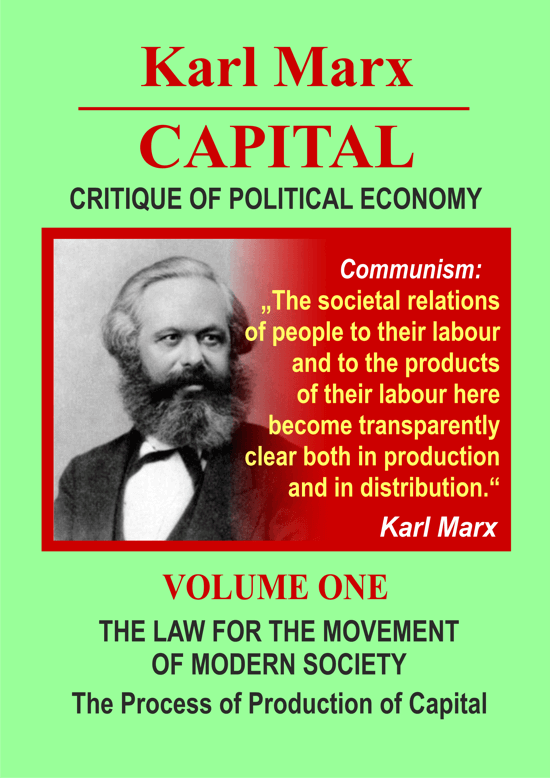
Click To Receive
Volume ONE:
Click To Receive
Volume TWO:
Click To Receive
Volume THREE:
Click To Receive
Volume FOUR:
You can continue from
HERE
You can continue from
HERE